After last Sunday’s encounter with the swans I was curious to learn more about them and some of the other birds I have seen here.
Again walking this weekend, but not as far, a few of the local ponds, with the weather warming, not only is the tundra starting to produce shades of silvery green with the willows
  and sedge grasses, odd splash
  of white, purple and yellow
 as tiny mountain avens, saxifrage, dwarf fireweed emerge, Note that the willows
  are different sizes including this bush of about 18 inches.
  The other critters coming out are the mosquitoes….my hoodie and sunglasses were helpful.
  this shot was taken about 9 PM.
Leashed together,  the dogs again amused themselves by alternately taking turns digging in the sik sik holes….for at least half an hour and to the point
  that almost the whole body was submerged.
  Also discovered an old seal skin to roll in….
 Believe me there were baths and brushes after that.
This gives me some time with the binoculars….three tundra swans were curious and swam over. When feeding, they turn totally upside down with feet in the air probing for plants in the muddy bottom of the shallow ponds. Tundra swans, also called whistling swans, mate for life, only molt once a season and unlike geese which remain in colonies, both raise the cygnets, build solitary nests, often on a high point, such as a hummock….this gives them a long distance to see predators or other over the tundra. As the sedge grasses grow the nests are more hidden.
The eider ducks have a rounded curved profile to the head and beak, the male with a black head and under belly and white stripe that starts at the beak and stripe to the back. Also saw what I think was a brown and white with black and white head, plover or sandpiper, about 6” tall, when walking in the marshy area, obviously trying to divert us from the nest. The bird spread out its wings and did a wobbly dance from rock to rock.
According to E.C. Pielou A Naturalists Guide to the Arctic the number of bird species that migrate to the arctic and come to breed are well over 100, whereas the year round birds are only 11 species: gyrfalcon, raven, rock and willow ptarmigans, Ross and ivory gulls, thick billed murre, dovekie. snowy owl, redpoll and black guillemot.
Tundra Swan
Cygnus columbianus
Found along marshy
stretches in the summer and the southern coast of the Northwest
Territories in winter. The nest is made up of moss or grass and is
frequently located close to a body of water. Each pair lays anywhere
between three to five eggs which are incubated for approximately forty
days. Whistling swans can be observed in great numbers in Ontario
during their spring migration.
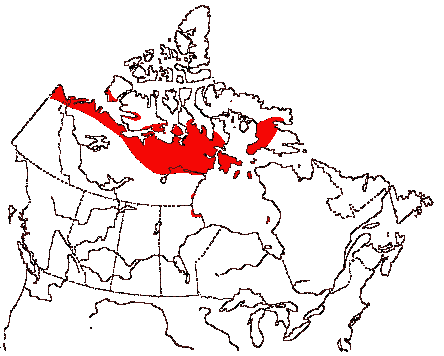
 Distribution
of Tundra Swan in Canada
Common Eider
Somateria mollissima
This diving duck inhabits
the coasts of Canada's far north, sometimes wintering in the more
southern reaches of the Atlantic and Pacific coasts. The female eider
plucks her own down to line her nest; this down is highly valuable to
the eiders as insulation against the arctic sea.
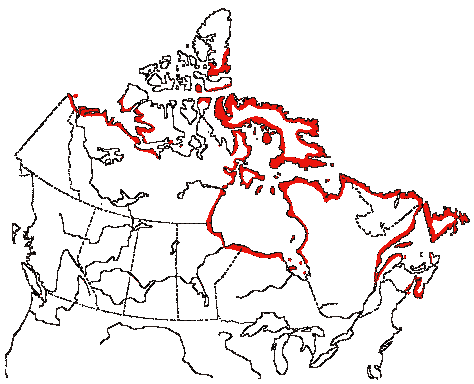
Distribution
of Common Eider in Canada
http://canadianbiodiversity.mcgill.ca/english/species/birds/index.htm

Recent Comments