 Happy New Year’s to you and your family!! All of the best in 2013.
Uncategorized
-
Best wishes for the New Year!
-
Christmas wishes to all!
“In the bleak mid winter” or so the carol goes, definitely can describe Alberta weather!
 But it is my wish, especially with many tragic world events, you and yours will find some Peace and Warmth! “
  The Light shone in the darkness and the darkness did not overcome it” John 1:5
This morning after some busy weeks, the dogs and I are heading out to the city to a Country Christmas in Rocky Mt. House and then a few days with family in Calgary. Dogs no doubt will be chasing branches and several days in day care but presented with lovely colored scarves.

November and December have gone very quickly and other than some outside lights, found abit difficult to get into the Christmas spirit, with any household decorations. However a tree was found, cut and decorated! Abit of a story on this one as is from my front yard...

I have cedar, juniper, spruce and pine trees...this juniper branch hung heavily over the side walk blocking side of house so used my pruning saw to cut it down... set up involved a fair balancing act with string and screws and further trimming.
 Also managed some homemade photo cards, a few Christmas cards got sent and volunteered gift wrapping at Meals on Wheels...
Gatherings with a some friends
 and family
  including my brother Don
  who was in Edmonton around his YMCA x-c bike ride this past summer...
-
Advent Wishes
It has been a while since did any personal blogging and tonight pulled out the box of cards & letters from the past year (s), started on a few handwritten cards and realized have missed is being in touch through my seasonal newsletter and also here.
I am writing this from Edmonton, on a snowy December evening, a hunkering down weekend temperatures plunging to minus 30,
 Hope this finds you, my xanga readers, well in anticipation of the Advent season “ to come “ as we await the celebration of the birth of the Christ Child.and contemplate the coming year with both its joys and challenges.
 Wishing you times of simplicity
 as the season can be one of many activities…big dinners, gift giving, mad shopping, and in this digital age, dashing off a tweet, a text, or a facebook update.
 -
Bears and mosquitos...hazards of a summer camp on Baffin Island.
For those of you who know my interest in the arctic, I found the following article and video on this archeologist has been working for many year on a project outside of Kimmirut Nunavut called Nanook which has evidence of links with the Norse possibly 500 years before any other European contact...Take some time to explore the article and the video on the Nature of Things originally aired..The Norse: An Arctic Mystery..Thursday November 22, 2012 AT 8:00 PM on CBC-TV...http://www.cbc.ca/natureofthings/episode/the-norse-an-arctic-mystery.html#Bears and mosquitos...hazards of a summer camp on Baffin island....here is the original article.
Synopsis: "The Norse: An Arctic Mystery"Buried under the tundra on a windy cape of Baffin Island lies one of the most important archeological finds in Canada. An untrained eye would miss it—but not scientist Pat Sutherland. Her new work here at the place they call Nanook will likely change history.

Pat Sutherland working on Baffin Island
Listen to an interview with Pat Sutherland on As It Happens.Dr. Sutherland has been working on the archeology of the Arctic for more than 30 years. Her expertise is the ancient native people who lived there. But along the way she started finding artifacts that didn’t fit—pieces that weren’t made by indigenous hands, but by Norse traders, possibly as far back as a thousand years ago.
Is it possible that someone was here from the other side of the Atlantic, centuries before the arrival of Columbus or Cabot? Is it possible that this is the site of first contact between native North Americans and Europeans?
The new documentary film THE NORSE: AN ARCTIC MYSTERY follows Sutherland on her journey to prove that the early history between North America and Europe did not unfold the way the history books say it did.
“The Norse were here over a long period of time, and they had business to do,” says Sutherland. The dig at the Nanook site has revealed signs of a structure—stone walls marking out the shape of an trading post—possibly the first European building this side of the Atlantic.
“It certainly substantiates that there were Europeans on the site,” says Sutherland, “no question about that.”
THE NORSE: AN ARCTIC MYSTERY follows Sutherland from the south shore Baffin Island to the Outer Hebrides in Scotland, the departure point for Norse sailing west, searching for trade goods like ivory and furs across the North Atlantic to Canada. In Denmark a crew of latter-day Vikings lifts the sails on a reproduction of an ocean-going ship. And in Ottawa Sutherland gets down to the hard science—using state of the art technology to unlock the hardest kept secrets of Norse arrival on Baffin Island.
“I think we’ve only just begun to delve into what the Norse were doing there,” says Sutherland, “and we’ve just got the beginning of the story.”
In the spring of 2012, Dr. Pat Sutherland was dismissed from the Canadian Museum of Civilization after working there for 30 years. She was most recently the curator of Arctic Archeology. Dr. Sutherland is contesting the dismissal through her union, so she can regain access to her research. Currently the Helluland Project has been suspended.
THE NORSE: AN ARCTIC MYSTERY is produced by 90th Parallel Productions in Toronto. Gordon Henderson is Executive Producer. THE NORSE: AN ARCTIC MYSTERY is produced, written and directed by Andrew Gregg.
I find the timing this news rather disturbing, as this archeologist has been working for many years on this project outside of Kimmirut..http://www.canada.com/mobile/iphone/story.html?id=7591294Dr. Pat Sutherland working at an archeological site on Baffin Island known as Nanook. She believes the excavation was a building established by the Norse (aka Vikings) around 1300 or possibly earlier so they could trade for furs, narwhal tusks and walrus ivory prized by nobility in Europe. The story of Sutherland’s research will be told on the CBC show The Nature of Things on Thursday, Nov. 22.Photographed by:
Handout photo, 90th Parallel ProductionsOTTAWA — This should be the best of times for Pat Sutherland. November’s issue of National Geographic magazine and a documentary airing Thursday night on CBC’s The Nature of Things both highlight research the Ottawa archeologist has been doing in the Canadian Arctic for the past dozen years that could fundamentally alter our understanding of our early history.
If Sutherland is right, Norse seafarers — popularly known as Vikings — built an outpost on Baffin Island, now called Nanook, centuries before Columbus blundered on to North America. Moreover, there’s evidence they traded with the Dorset, the Arctic’s ancient, now-vanished inhabitants, for as many as 400 years.
”That’s incredible,” says Andrew Gregg, who wrote, directed and produced The Norse: An Arctic Mystery, the CBC documentary that recounts Sutherland’s findings. “That rewrites all the history books.”
But Sutherland’s pleasure at the recognition her discoveries are receiving has been sharply tempered by a harsh reality. Last April, even as the documentary about her work was being filmed, the 63-year-old, then curator of Arctic archeology at the Canadian Museum of Civilization, was abruptly dismissed from her job.
At the same time, museum officials also stripped her husband, Robert McGhee — himself a legendary Arctic archeologist described as “one of the most eminent scholars that Canada has produced” — of the emeritus status it had granted him after his retirement from the Gatineau museum in 2008.
No one involved will say why the museum severed its relationships with Sutherland and McGhee. When asked, Sutherland responds hesitantly, choosing her words with care. “I can’t really talk about my dismissal,” she says.
Her union, the Professional Institute of the Public Service of Canada, is treating her firing as a wrongful dismissal, but won’t comment because the case is before an arbitrator.
Museum officials also decline to offer an explanation, though Chantal Schryer, the museum’s vice-president of public affairs, says the reasons are well known by Sutherland and her husband.
“They both know exactly why Dr. McGhee lost his emeritus status,” Schryer says. “And she knows why she is no longer an employee of the museum.”
Two sources told the Citizen that the rupture followed a year-long external investigation into allegations of bullying and harassment. But they are unwilling to speak on the record, and neither Sutherland, her union nor the museum discuss the matter.
Gregg suggests Sutherland’s dismissal may be linked to the museum’s impending transformation into the Canadian Museum of History. “It’s a complete shift in ideology,” he says. “The narrative that’s coming out through this government and our institutions has no room for a new story about the Norse.”
However, Schryer flatly denies that. The departure of Sutherland and McGhee “has absolutely nothing to do with the change of name and change of mandate,” she declares.
Sutherland — the only female archeologist the museum has ever employed — won’t comment on that. But, she points out, “people have expressed concern that the announced changes are going to lead to a neglect of archeology and ethnology, and my work comes under that heading.”
Schryer says the museum “remains interested in archeology, including in the Arctic.” However, it’s clear the museum is committing fewer resources to that area than it has in the past.
Since Sutherland’s departure, it no longer has a curator of Arctic archeology and none of its eight archeologists is devoted exclusively to Arctic research, though museum officials say one is working on a project related to the Arctic. A few years ago, the museum had five Arctic archeologists on staff.
The whole episode has been traumatic for Sutherland, who had been associated with the museum for 28 years and was hired 12 years ago to run the Helluland archeology project. (Helluland was the Norse name for Baffin Island and adjacent part of the Eastern Arctic.)
“It’s had a profound effect,” she says. “This work was important to me, and I thought it was important to look at a new aspect of early Canadian history.”
Until now, the only confirmed Viking settlement in North America was at L’Anse aux Meadows, established around the year 1000 at the northern tip of Newfoundland, now a UNESCO World Heritage Site.
But archeological evidence suggests the Norse only stayed for a decade or so, and there’s no sign that they traded with the natives. There’s not even any archeological evidence that the Norse at L’Anse aux Meadows had contact with the aboriginal population, though Norse sagas — oral histories written down two or three centuries after the events — tell of the settlers being driven away by fierce and unwelcoming natives.
Current evidence suggests the Nanook site on southern Baffin Island, about 25 kilometres from the village of Kimmirut, was established around 1300 AD, though Sutherland says it could date from a much earlier period. If so, it’s conceivable that Nanook was the place of first contact between native North Americans and Europeans.
The site was originally excavated in the 1960s and at the time, was thought to be a Dorset settlement. But based on evidence she has painstakingly assembled over a dozen years, Sutherland says she’s certain the Nanook site is of European origin.
“I’m very confident that what we have is an indication of a Norse presence in the Canadian Arctic that we weren’t aware of before, that it was over a longer period of time, and that the interactions with the aboriginal people were more complex and extensive than we thought before.”
It’s a “no-brainer” that trade would have been involved, Sutherland says. The Dorset had the goods, including walrus ivory, narwhal tusks and furs, that the Norse were after. And they were only a two-day sail from Norse outposts in Greenland. “One could reasonably argue that the travels to the east coast of Canada, to the Arctic, was over a period of four centuries,” she says.
As Sutherland has accumulated evidence, her conclusions have become more widely accepted within an initially skeptical archeological community.
James Tuck, an emeritus professor of archeology at Memorial University in St. John’s, Nfld., says Sutherland’s evidence “seems to be getting better all the time.” He adds: “She’s created a project that has brought together all kinds of different lines of evidence and experts, and they all are pointing in the same direction.”
Tuck called Sutherland’s dismissal from the museum of civilization a “tremendous setback” for the project. ‘I don’t think it’s a death knell, but it’s damn close to it.”
Some of the artifacts Sutherland had assembled were on loan from other institutions, and within days of her dismissal, they were sent back to museums in Newfoundland and Greenland. Others belong to the government of Nunavut. Negotiations are under way between the museum and Nunavut to determine their fate.
Sutherland intended to co-publish her findings with 15 international collaborators, but her dismissal dashed those plans. She also wanted to work with the community of Kimmirut to get national historic site designation for the Nanook site, something that would have generated tourism and jobs. “There’s a lot of disappointment and dismay that this work isn’t going ahead,” she says.
Sutherland’s main objective now is to regain access to her research. But whether that happens hinges on the resolution of her dispute with the museum. “We are in discussions with Dr. Sutherland and her representative, trying to solve issues,” Schryer says. “Dr. Sutherland is not being denied anything. We just need to solve some past employment issues.”
That can’t happen soon enough for Sutherland.“I’m excited about what we found,” she says. “I think it’s significant. I think it’s a project that is of interest to the Canadian public.
“I really want to be able to complete this work. At this stage in my life, this is kind of a legacy, I guess.”
dbutler@ottawacitizen.com
© Copyright (c) The Ottawa Citizen
-
The Canadian Y's, teens and fitness
For those of you who know my brother Don Patterson here is a recent article when he was last in Edmonton on teens, obesity and fitness... Cross-Canada bike trip fuels YMCA campaignwww.edmontonjournal.com
Don Patterson of Mississauga, Ont., cycled from Vancouver to St. John’s, N.L., to raise awareness about teen obesity and to raise funds for local Ys.
Photograph by: Ed Kaiser , Edmonton Journal
EDMONTON - Concerned about the rising number of Canadian teens who are overweight or obese, Don Patterson booked off four weeks vacation, jumped on a road bike, and did something about it. From June 25 to July 23 the 58-year-old pedalled 7,232 kilometres from Vancouver to St. John’s, N.L.
He did it, he explains, to make people aware of the fact that for the first time in recent memory, teenagers face a lower life expectancy than their parents. They need to become physically active if they want to live longer, he says, but they would get so much more than longevity.
Ten years ago, when Patterson went back to school to get an MBA (masters of business administration), he studied the relationship between active kids and higher academics.
“The basic conclusion was that active kids lead to higher academics, lead to skilled jobs, lead to a stronger economy,” he says. Besides doing better in school, active kids are also less likely to become juvenile delinquents, they’re better time managers and they eat more healthfully, he adds.
The findings inspired him to talk to his local YMCA in Mississauga about developing more teen programs including a teen triathlon that he spearheaded and is now being rolled out in other Ys in the GTA (Greater Toronto Area) and being considered by Ys elsewhere.
Patterson’s three kids are adults now, but when they were kids, he remembers they basically grew up at the Y, taking programs from swimming and gym to summer camps, life guarding and camp counselling. He wants all kids to have the same opportunity irrespective of their families’ financial resources, their physical abilities or their cultural background.
The YMCA welcomes all kids and subsidizes those that can’t afford membership fees, but they depend on private and corporate donations to do it, he notes. And that is why the native Edmontonian flew into his hometown last week. He was supposed to be the keynote speaker for the YMCA’s annual donor appreciation dinner, but the event was cancelled because of the big snowstorm.
Undeterred, Patterson, who has raised more than $25,000 so far for the YMCA Strong Kids Campaign to give more kids access to life-enhancing YMCA programs and services, continues to travel to Ys across the country speaking about his trip and the need for donations. Every dollar raised locally goes to the local YMCAs, he explains. He even covered all the costs of his bike trip, which, apart from the cost of the bike, amounted to about $6,000 or $7,000.
The most thrilling part of the trip, apart from the breathtaking scenery, Patterson says, was visiting local YMCAs along the way and having a lot of local kids come out to greet him.
“That really made the trip for me, because you could see where exactly your money is going.”
Some of the guys at the Mississauga Y have been teasing him about doing a fundraising ride from Inuvik in the north to the southern tip of Ontario, “but right now I don’t have any plans,” he says laughing.
Patterson’s journey, including stories, photos and media articles, are chronicled on his personal blog ykids.blog.com. It also includes links to donating to your local YMCA.
© Copyright (c) The Edmonton Journal -
Lest We Forget / Abide with me...November Remembrances
November has always been a month of remembrances for me personally and of course nationally we remember those who have fallen in war time conflicts. Thus came on this video which touched me and thus sharing.A tribute to the fallen. Slideshow of pictures with the Hymn, Abide with me and the last Post as soundtrack.The hymn Abide with Me is one that is sung at the end of the day through many camping experiences for my family at Pioneer Ranch Camp. It is also one I would like at the memorial service for my daughter on Thursday.Abide with me; fast falls the eventide;
the darkness deepens; Lord, with me abide.
When other helpers fail and comforts flee,
Help of the helpless, O abide with me. -
Torngat Mountains National Park
Touched by the north again in documentary film at Lit fest today...NORTHWORDS trailerNORTHWORDS trailer from filmCAN on Vimeo.
Screening this summer + fall across Canada -NORTHWORDS tells the story of a literary expedition above the tree line led by award-winning journalist and activist Shelagh Rogers. In the summer of 2011, Rogers handpicked five of Canada's leading writers to accompany her to a remote corner of northern Labrador to explore and seek inspiration, and to instigate new stories and conversation about the north. The film tracks the group as they navigate the harsh and stunning terrain of Torngat Mountains National Park - the country's newest national park, and a place steeped in geological and human history. Along the way, they learn about issues facing the north today, and confront some of the dark moments in its recent past. Featuring Joseph Boyden, Sarah Leavitt, Rabindranath Maharaj, Noah Richler and Alissa York, the film shows what happens when some of the country's best writers tackle one of its most overwhelmingly beautiful places. -
Found Poetry October 2012
Yesterday in my creative writing group, we explored found poetry....this is a piece from from an original writing piece in Jan 2011
Drifting filling in my driveway, sidewalks, porches and railings,
Melting spots around the blue and white Christmas lights,
Invading spaces of neighbourhood sidewalks, urban freeways and back lanes,
Continually doing battle with shovels, plows, blowers, devices made to battle and conquer,
Walking crunch, crunch the sound of boots,
Dripping real icicles, not the tinsel with which we laden our Christmas trees,
Foraging chickadees beneath laden branches of spruce,
Slowly coagulating circular crystalline pans into larger masses, the precursors to the still frozen North Saskatchewan River:
Officially declared office closure by four government departments,
Pre-arctic blizzard,
Rising temperatures from minus 30oC to a balmy 10-15 o C below and in the warmth, there is a lull, a calm in which large flakes scatter through the night and almost Christmas like in March.
That white stuff whatever we call it…. a blessing if we let it be!

SNOW
-
Pumpkin Pies from Scratch and Wine bottle as roller
On the Thanksgiving weekend spent with family on Vancouver Island, beautiful weather and a field full of pumpkins from a local farm.
 Good fun making fruit and pumpkins pies and tarts
 totally from scratch and thought I would share some of my photos...even discovered if no rolling pin a wine bottle will do.
My pastry recipe..Granny's “No Fail” Pastry

Put one egg, 3T lemon juice and enough water to make one cup...mix and set aside in fridge. Sift together 1/2 t. baking soda, 5 cups flour, 2T sugar, 2 t. salt. slowly add 1 lb. of Tender Leaf lard, cutting into a consistency of oatmeal. Add egg mixture, mix lightly, form into a ball. Chill and use as needed. Makes 3 double pie crusts and extra dough can be frozen.
© Olga PayneSource: http://www.pickyourown.org/pumpkinpie.php
Step 1 - Get your pie pumpkin
 "Pie pumpkins" are smaller, sweeter, less grainy textured pumpkins than the usual jack-o-lantern types. Grocery stores usually carry them in late September through December in the U.S. In some parts of the country, they are also called sugar pumpkins or even "cheese pumpkins". Go figure that one. Note: the Libby's can of cooked pumpkin is just there for reference - it is the small can, so that gives you an idea of the size of a typical pie pumpkin. They're only about 6 to 8 inches in diameter (about 20 to 24 inches in circumference). TIP: If you're in a pinch and can't find a pie pumpkin, here's a tip: butternut squash taste almost the same! And many farmers will tell you that "Neck Squash", Jarradale Blue Hubbard, Cinderella and Long Island Cheese winter squashes are all considered to make a better tasting pumpkin pie. Commercial canned pumpkin is from a variety of butternut, not true pumpkins! If you insist on using a regular Jack O' Lantern type pumpkin, you may need to add about 25% more sugar and run the cooked pumpkin through a blender or food processor to help smooth it out.
Just like selecting any squash, look for one that is firm, no bruises or soft spots, and a good orange color. One 6" pie pumpkin usually makes one 10 inch deep dish pie and a bit extra; or two 9 inch shallow pies! If you have extra goop, you can always pour it into greased baking pans and make a crustless mini pie with the excess (and the cooked pies do freeze well!)
If you live in the Far East (Thailand, Japan, Korea, Hong Kong, etc.) and cannot get a pumpkin or a butternut squash, I'm told that Japanese pumpkins make a great substitute. Just cube the meat into small cubes and steam them for 35 minutes. The rest of the preparation is the same and I'm told the taste is great.
Step 2 - Prepare the pumpkin for cooking
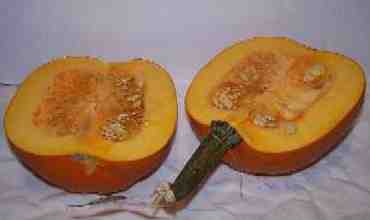 Wash the exterior of the pumpkin in cool or warm water, no soap.
Cut the pumpkin in half.
 A serrated knife and a sawing motion works best - a smooth knife is more likely to slip and hurt you!

Step 3 - Scoop out the seeds...
And scrape the insides.
 You want to get out that stringy, dangly stuff that coats the inside surface. I find a heavy ice cream scoop works great for this.
Note: SAVE THE SEEDS:

The seeds can be used either to plant pumpkins next year, or roasted to eat this year! Place them in a bowl of water and rub them between your hands. then pick out the orange buts (throw that away) and drain off the water. Spread them out on a clean towel or paper towel to dry and they're ready to save for next year's planting or roast.
Step 4 - Cooking the pumpkin
There are several ways to cook the pumpkin; just choose use your preferred method. Most people have microwaves and a stove, so I'll describe both of those methods here. But others make good arguments in favor of using a pressure cooker or baking in the oven. At the end of this document, I’ve included alternative instructions to replace step 4, if you’d rather use a different method.
Method 1 - Bake in the oven
You can also bake the prepared pumpkin in the oven, just like a butternut squash. This method takes the longest. Basically, you cut and scoop out the pumpkin as for the other methods, place it cut side down into a covered oven container. Cover the ovenproof container (with a lid), and pop it in an 350 F (165 C) oven. It normally takes about 45 minutes to 90 minutes (it can vary a lot!); just test it periodically by sticking it with a fork to see if it is soft!
Method 2 - Steam on the stovetop
You can also cook it on the stovetop; it takes about the same length of time in a steamer (20 to 30 minutes). I use a double pot steamer, but you could use an ordinary large pot with a steamer basket inside it!:
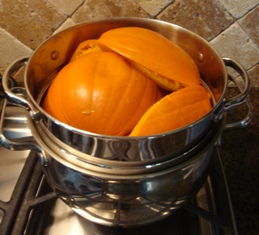
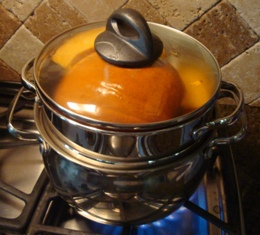
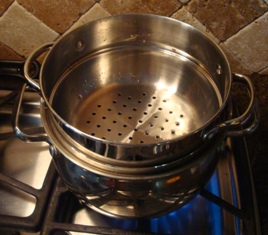
Put it in a microwaveable bowl
Remove the stem, and put the pumpkin into a microwavea
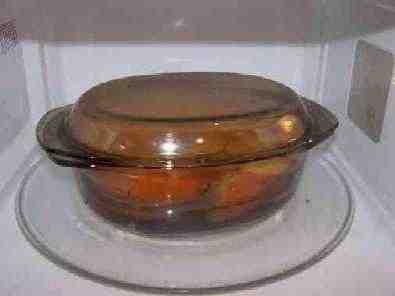 ble. You may need to cut the pumpkin further to make it fit. The fewer the number of pieces, the easier it will to scoop out the cooked pumpkin afterwards.
Put a couple of inches of water in the bowl, cover it, and put in the microwave. I cook it on high until it is soft. That may take 20 minutes or more, so like anything else, try 15 minutes, see how much it is softened, then do 5 minute increments until it is soft
Cook the pumpkin until it is soft
Whichever method you use, cook the pumpkin until it is soft and will separate from the skin.
Step 5 - Scoop out the cooked pumpkin

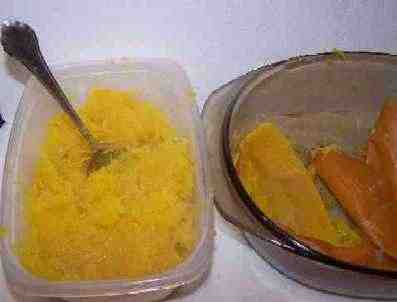 Whether you cook the pumpkin on the stove, microwave, or even the oven, once it is cooked until it is soft, it is easy to scoop out the guts with a broad, smooth spoon, (such as a tablespoon). Use the spoon to gently lift and scoop the cooked pumpkin out of the skin. It should separate easily an in fairly large chucks, if the pumpkin is cooked enough.
Many times the skin or rind will simply lift off with your fingers (see the photo at left) . I'll bet you didn't realize making your own pumpkin glop... err, "puree" was this easy!
Note: there are many varieties of pumpkin and some make better pies that other (due to sugar content, flavor, texture and water content. Drier, sweeter, fine-grained pies; the small (8" across) ones called "pie pumpkins" are best.
THIS is the best photo...drinking Alley Kat beer called PUMPKIN PIE!


Recent Comments